

You already know this post isn’t going to contain great sadness, romance, pain, or fear because I did not title it K-DRAMA. So for the anxious members of my audience, you can relax now. I figured I should sit down and capture some notes about our recent vacation to South Korea before I forget anything. In addition, by definition a personal post in my blog is, by any definition a K(Kirsten) Journal. Here are some of my initial takes about our recent vacation. If you need to see pictures, refer to the album posted here.
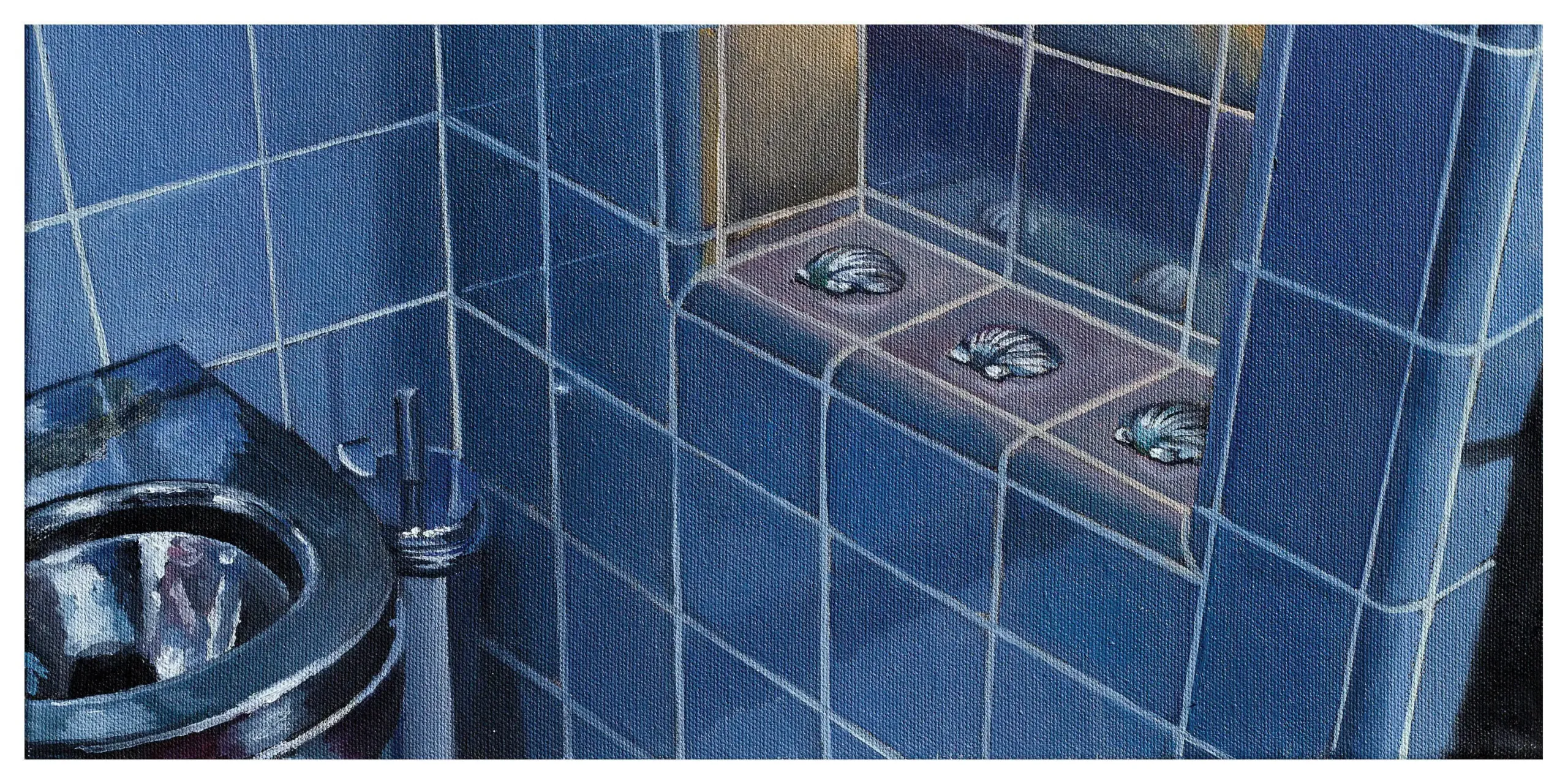
The Three Sea Shells
The “three seashells” are a famous, unexplained running gag from the 1993 sci-fi movie Demolition Man, representing a sterile, overly polite future society where even the instructions for how to operate the toilet must be gently coded.
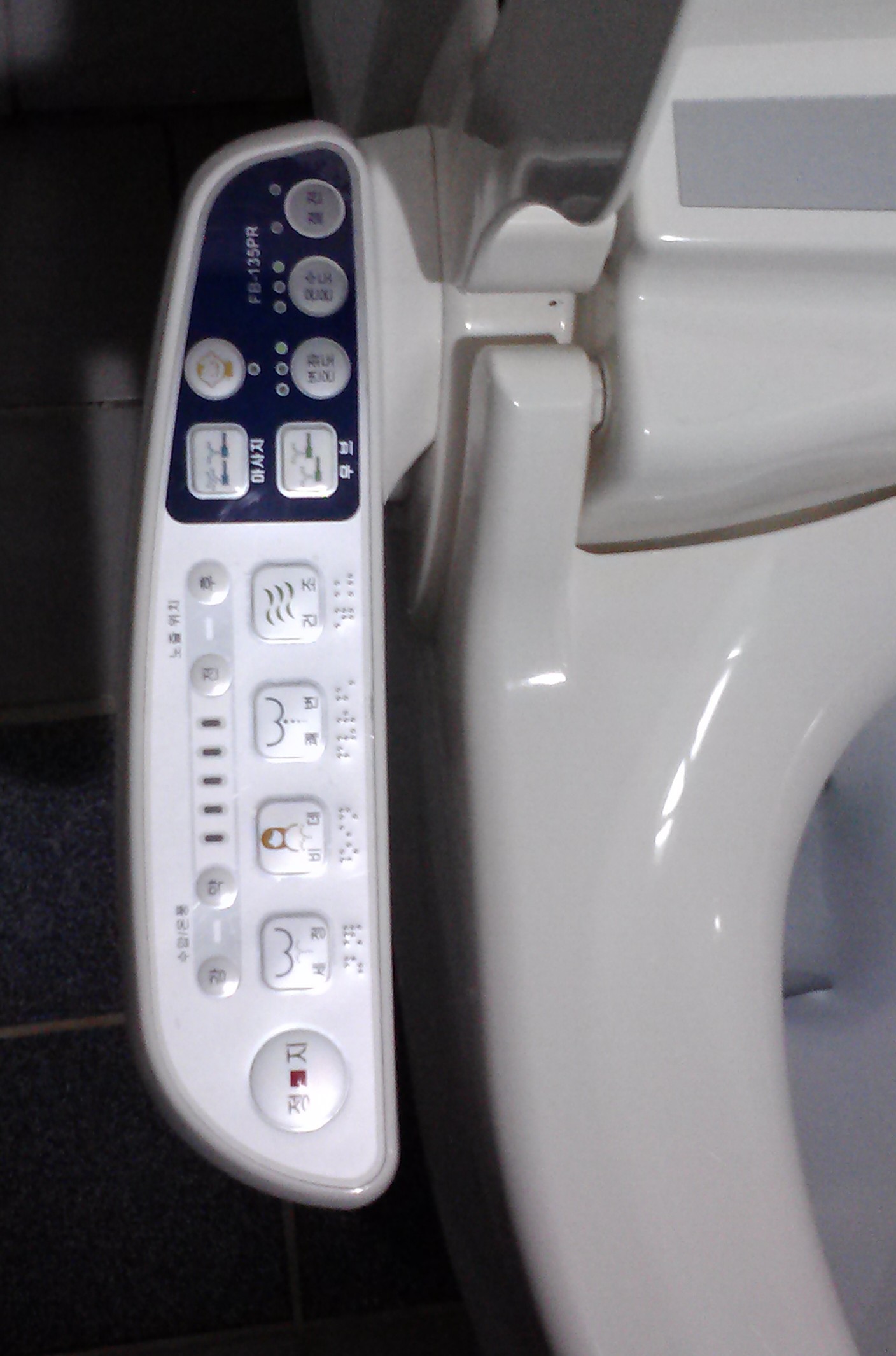
I lack sophistication. I grew up in a household with the most basic white American Standard toilet available in the late 1960s, and even though I have since lived in 2 apartments and 4 houses, I have only had variations of the same. Even when I actually needed to buy a new one for my current house, it didn’t occur to me to seek out the latest in toilet innovations. As a result, while I am aware that some toilets have advanced features and that there is such a thing as a bidet and have a general concept of how it works, the only toilet variations I have encountered in my life were outhouses in rural areas and Asian squat toilets, neither of which could be described as “advanced”.
It’s late at night, I have been travelling forever, we just got into our hotel room and I am presented with a toilet with an entire control panel. As I entered the bathroom, the UV light went from dim to bright and dim again inside the bowl and the water cycled to let me know it was fully ready for whatever I wanted to do. Not to be scared off so easily, I sat down, and I produced a mild “YEEP!” sound as my butt cheeks made contact with their first heated toilet seat. I felt a great wave of fondness for the device already, but working my way through a large number of buttons, some of which had multiple settings, was going to be an experiment with some amount of uncertainty, given as that it was labelled in Korean. Depending on the bathroom, throughout the trip, they had more or less buttons, with and without “intensity” settings, and only ONE the whole time had labels in both Korean and English (my personal Rosetta Stone).
What do the buttons do? In which order do you push them? I’m not going to spoil the fun for you if you haven’t already learned this, but I can say… it’s really fun teaching an old dog new tricks. I’ve never had a justifiable reason to replace a perfectly functional toilet in my home before, but I am considering moving into the future so that one of these things can become part of our family.
Why go to South Korea?
There are a bunch of answers to the question of why I chose South Korea as our travel destination:
- I drafted a list of destinations when I was young, seeking to develop a deeper and positive understanding of countries that had been attacked by the USA. I’ve only covered a few of them so far (Vietnam, Cambodia, Indonesia). Korea and Japan were the next two obvious ones before figuring out how to visit the Middle East (which is so off the table this year I don’t have words for it);
- I wanted to go to Japan for a really long time in a search for ancient Japanese sites (not it’s modern wonders), but my desired trip was super-expensive and prices were more reasonable for South Korea right now, and they had somewhat similar material cultures (sorry… I can be super-driven by a desire to see things and then take half-assed pictures of them);
- My excitement over recent trade talks between South Korea and Canada, and Hanwha’s current bid for a comprehensive defense and industrial partnership centered on the Patrol Submarine Project, including building advanced KSS-III submarines, domestic manufacturing of armored vehicles, and massive investments in Canadian steel and shipyard infrastructure. We both have a shared interest in trying to defend our sovereignty; and
- The reason that that finally pushed me in this direction is that I have been watching a Vietnamese-born American podcaster called Chris Norlund who now living in Busan, South Korea with his Korean wife for the last year and they have been sharing details of their daily life there that have intrigued me, suggesting that South Korea has a lot to teach Canada.
How was the food?
The most important part to convey is that the food is fundamentally healthy. A variety of vegetables at every meal, focusing on a reasonable portion of meat (usually grilled fresh at the table) complemented by banchan (think four to eight small bowls of side dishes to give you a couple tablespoons of a wide variety of flavours and textures). Pickled, fresh, steamed, salted, braised, fermented. There is always kimchi, but what vegetables and spices are in it vary from place to place. There is always a small bowl of rice. There are more kinds of green leaves to wrap your grilled bits in than you can count, and they are sweet, bitter, minty, salty, and neutral and so very much not-just-lettuce. Every meal they served more food that Michael and I could eat, but no matter how much you DID eat, you never felt regret later. No aches, no bloating, no feeling that you have done something awful to your body.
There’s one exception to the “reasonable portion of meat” rule. Fried chicken. They take this seriously. Korean fried chicken shares zero DNA with Kentucky Fried Chicken, unless you remember what it tasted like in the 60s and early 70s. Yes, it is breaded, but the breading doesn’t make you feel heavy later. Yes, it is fried, but the oil doesn’t make you feel queasy later. Yes, it is chicken, but they appear to be happy, chicken-tasting chickens that didn’t die a horrific death after an antibiotic-fuelled life. All that being said, Korean fried chicken needs to come with a warning. Michael and I went out for dinner one night. We weren’t feeling very hungry, so Michael ordered the fried chicken and I ordered a side of fries, figuring we would split the dishes between the two of us. There’s maybe 3 pieces of chicken in an order of fried chicken, right? There weren’t any sizes on the menu to give us a sense of scale. What we failed to comprehend is the definition of an order of chicken in South Korea is one chicken. An entire chicken, cut up, lovingly breaded, delicately fried and drained and brought to you in a basket. Ten or eleven generous-sized chunks. That would have been daunting on its own, but my fries arrived in a similar-sized basket. We ate. We kept on eating. We did our best, and only left one piece in the basket because we feel horrible about food waste. We ate a small amount of fries, feeling that wasting meat was a greater sin than wasting potatoes. The whole meal cost $22 dollars Canadian, which wouldn’t buy two fast-food burgers with fries and drinks that we would have regretted eating even before we finished the meal.
Korean fried chicken and beer is a big thing there, and it shouldn’t be missed. Just come hungry, or with friends.
Public Infrastructure
Canada has 41.5 million people spread over 9,984,670 square kilometres. South Korea has 51.6 million people spread over 100,400 square kilometres. Canada’s population is mostly squished into the 100 kilometres north of the US border. South Korea’s population is mostly squished into the valleys between mountains and steep hillsides. From the moment I arrived, I was in awe of South Korea’s public infrastructure.
The highways and roads are new, multi-laned, well-marked, clearly signed (a frequently bilingual in English), well-lit, well-drained, well-maintained, and largely free of congestion. The only three moments we experienced something a person from Toronto or Montreal would consider irritating traffic were in the downtown cores of the two largest cities, and that slow bit only lasted 15 minutes. In spite of the daunting challenge of non-stop mountains, they punched through them with spacious, well-lit tunnels and over riverine chasms with pretty bridges. Constructing even a few of these tunnels or bridges would cause decades of political strife over the cost in Canada, let alone hundreds of them. The sidewalks are exceptionally spacious and wide, with perfect edges and wheelchair ramps at the intersections. There are pedestrian crosswalks everywhere, and the well-mannered traffic is so clearly separated from the pedestrians and bikes that no one feels threatened anywhere. There are trains/subways in the major cities with excellent coverage, trains between the major cities, and bullet trains between the largest cities. The buses and subways cost a dollar, regardless of how far you need to travel, ensuring that the majority of the population opts for public transit rather than private cars. Cars are usually rented for weekend outings and vacations, more often than for daily transit. Police are available along the highways, and it seems that they are there more for support than policing. We drove around the whole mainland and saw no evidence of people speeding or driving dangerously. It’s not just an urban thing… even the smallest towns we visited had modern, clean, and excellent roads. It was clearly evident that South Korea lets nothing get in the way of a well-developed transportation network that really seems to be working for its people.
As we drove throughout the country you eventually became aware that there were regular hospitals, fire departments, medical clinics, schools, public parks (with outdoor gyms and public washrooms as well), and community support centres of all sorts available everywhere you went. If you needed help, it looked like help was everywhere the people were… even in smaller towns. These public buildings were clean, modern, and somehow friendly and accessible in character. I’ve never seen a social safety net so clearly. We were told that there are some homeless people in South Korea, but we failed to see them anywhere. When our guide explained that anyone who needed support from a doctor could get it any time they wanted, as often as they wanted, so much so that some people spent extensive time visiting multiple doctors in a single day, seeking the best possible advice as to how to deal with a challenge for as little as $2 USD a visit, it suggested that having ready access to plentiful, modern aid might result in lower incidence of mental health crises, physical illnesses interfering with the ability to work or enjoy one’s retirement, and therefore substantially fewer ways for a person to fall through the cracks to become homeless. I need to study this more, because the surface view looked so incredible that I felt that there has to be some level of population not getting what they need, just somehow out of our range of vision. Even if this proves to be true, I’m in awe of the parts I could see.
Cell phone access cost Michael $3.99 USD for 1 GB of data. If only we could get that at home! Everyone around us had a reasonably-priced cellphone with an unlimited data plan that could be paid for comfortably even at part-time wages, meaning students and the elderly all had electronic access in a low-barrier environment that does not have a parallel in Canada. This is important, because your smartphone can be used to track busses, trains, order your coffee or lunch, pay for parking, or access to an attraction with absolute ease as long as you could read Korean. In some places, a substantial number of the interfaces were even available English to support tourists and immigrants, much to our delight.
The River Walk in Seoul
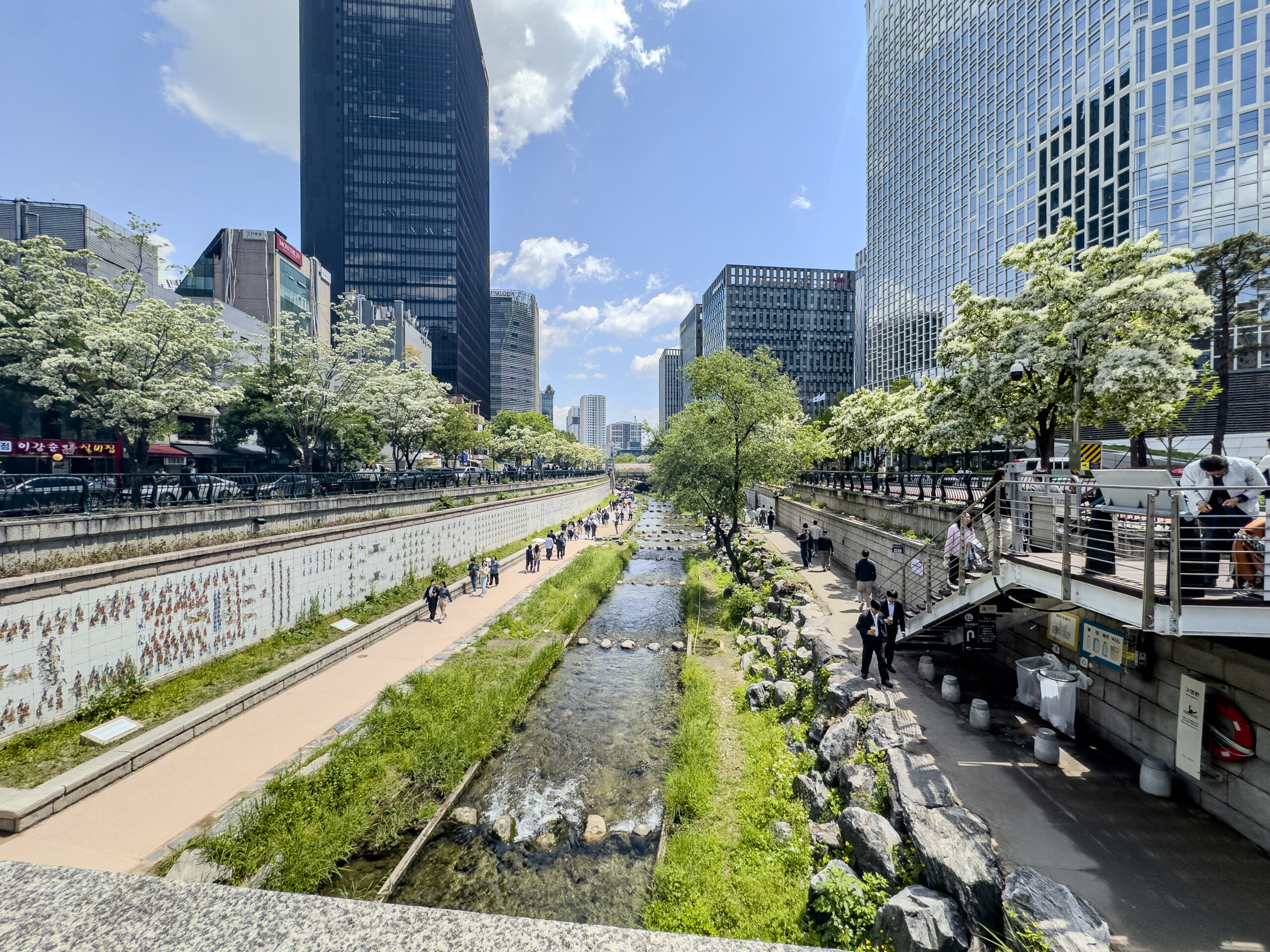
20260504 – Seoul Cheonggyecheon Stream
There is a free attraction on Seoul that I don’t think gets nearly enough attention. The 10.84 kilometre Cheonggyecheon Stream flows through the heart of Seoul, from Gwanghwamun to Dongdaemun. It is a transformed ecological park of natural beauty after 3 years of restoration project to un-bury the stream, completed in 2005. Picture this… the road runs in one direction on either side of the now re-exposed stream, with bridges crossing it periodically. From the road height, the land slopes down a re-enforced bank to the store. The stream has paved walkways along it that are accessed by stairways and elevators every so many blocks. Yes, elevators… this river walk has been fully designed to be wheelchair accessible, same as the streets above. Trees, bushes, grasses, and mosses have been planting to recreate little wetlands, beaches and protected banks along the stream. The river bed itself has been given care to produce areas that run faster or slower, create little rapids or waterfalls, or slow to gentle oxbow marshy bits. The city’s emergency drainage systems are hooked into sluice gates that can release excess stormwater from the city above into the river. There are safety and medical kits posted regularly along the embankment walls. The pathways are illuminated on darker days and at night there are dazzling light displays added. Benches and stools are scattered here and there to allow couples, families, and individuals a chance to pause and reflect on some natural beauty. The naturalization is a success: there are frogs, carp, and other fish swimming in the stream, hunted by grey herons and egrets. Small songbirds flit back and forth, nesting in the trees on the riverbanks.
Even though the area is popular with both locals and tourists, it doesn’t feel over-crowded. In fact, it feels like a private little escape, which makes the fact that you can see soaring skyscrapers up above surreal. People grab a snack in one of the shops up above, head down the stairs, and enjoy a few minutes of peace by the water before returning to work in the shops and offices above.
I live in London, Ontario, famous for its numerous river cutting through the city, bounded by public parks and walkways. I say this without reservation: this extremely urban example of stream restoration blew me away. I have great difficulty staying in a downtown area. It causes me anxiety being surrounded by so much concrete and glass, with a highly dense population, but the combination of Seoul’s exceptional sidewalk real estate, spacious and well-maintained roads, and this river walk meant that I didn’t tense up at all while in the greater Seoul metropolitan area (Sudogwon) that holds over 26 million people, which is equal to 63% of Canada’s ENTIRE population. I cannot deliver a higher compliment to city planners.
Travelling in a Mixed Tour Group
Our group of ten was composed of 8 Americans, 4 British, and 2 Canadians. As our guide Nam Min relayed to us historical content to prepare us for each of the sites we visited, it became increasingly evident that travel in a mixed tour group is… complicated.
After World War II ended in 1945, Korea was split into two occupation zones along the 38th parallel—the Soviet Union controlled the north and the U.S. controlled the south. No one asked the Koreans. The Korean War began on June 25, 1950, when the Soviet-backed North Korean People’s Army (KPA) launched a full-scale invasion of South Korea, crossing the 38th parallel in a coordinated attack. Driven by a desire to unify the peninsula under communist rule, North Korean leader Kim Il Sung aimed to seize South Korea, whose capital, Seoul, fell within three days. Nam Min related how the people in South Korea were unable to accept that their northern relatives were becoming a real threat. “But we’re brothers! We all live together peacefully!” And so it came to pass that South Korea was ultimately surprised by Northern aggression and betrayal, even though they had been warned by multiple UN sources. Two Canadians trying to find a safe place to look, four Americans oblivious to discomfort caused by the Don-Roe Doctrine.
One of the UK members of our tour group somehow got into a discussion about politics with one of the American men, leading to a prolonged description of how awful Obama was, how great plantations were, how ridiculous DEI is, how important it is to get rid of “illegals”, how countries are ruined by immigration, how important it was to stake other countries decisively, how it was absolutely okay for Trump to ignore the law as long as it achieved something “important”, and no amount of silent cues from the rest of the party could find a way to bring this monologue to an end. The tour guide helpfully interrupted with a description about some funeral mounds before I lost control. Never have I watched British and Canadian restraint tested so hard. How long can you hold your tongue, knowing there are still 4 days of vacation left with the group to survive? The next day, the same fellow pulled me aside, having been made aware that my face was somehow flashing some kind of displeasure (not a surprise, I was once told to shut up in a meeting at work where I hadn’t said a single word out loud… I do NOT possess a poker face). In his own way, I think he was trying to mend relations. He said that he knew that life in Canada was pretty awful and our economy sucked, but not to worry… all we had to do was win the Stanley Cup and maybe our luck would turn around. Folks, I need credit for the things I did not do to that man. I swallowed everything I was thinking and feeling and choked out something about hoping we win, too, since the Canadiens hadn’t brought home the Cup since I moved out of Montreal. No bloodshed.
So what’s less-great about South Korea?
Coffee. Don’t get me wrong, I’m sure their coffee is great… and they love an iced Americano so much that there seems to be a coffee joint every 4 storefronts. The problem lies in the fact that Michael works best when supplied with about two litres of drip coffee, served with cream and sugar. South Koreans don’t serve coffee with milk or cream (lactose intolerant population), use pumped sugar syrup, start with an expresso base, and serve them in sizes that look more experimental than substantive to my poor husband. We tried a different coffee place every day, and never got close to a Tim Hortons double-double. I’ll be the first to admit that’s not a great coffee, but is is his drug of choice, so that’s the standard the unfortunate South Korean Americanos were being judged unfairly against.
The no-color rule is a common observation that people have noticed in Korea, where everyone is wearing black, white, and grey, with hints of beige occasionally. It is linked to social and cultural aspects. It’s easier to stay low, and fit in socially and culturally this way. My wardrobe included blue, yellow, and orange, and I felt altogether gaudy when walking in public. If I still had my rainbow-coloured hair instead of the natural silver, I suspect I would have attracted outright stares and met with more reserved social interactions. Fitting in is very important, and North Americans delight in individualism too much to fit into South Korean crowds naturally. It would take work and careful effort to tone everything down to the right level… it’s not just clothes. It’s hair, voices, and mannerisms.
The way I have just described it isn’t quite right, though. While all of that is true, it is equally true that South Koreans are keenly aware of, and competitive, about their physical appearance. Am I too skinny/fat? Too short/tall? Is my skin too dark? Does it have imperfections, bumps, or pores? Are the eyebrows right? Are the lashes too much? Do my ears stand out too much? They all seem to have the raging non-stop criticism I levy against myself non-stop… but they also apply that harsh lens on each other. There’s some kind of national inferiority complex about looks going on, and even the most beautiful aren’t comfortable in their own skin.